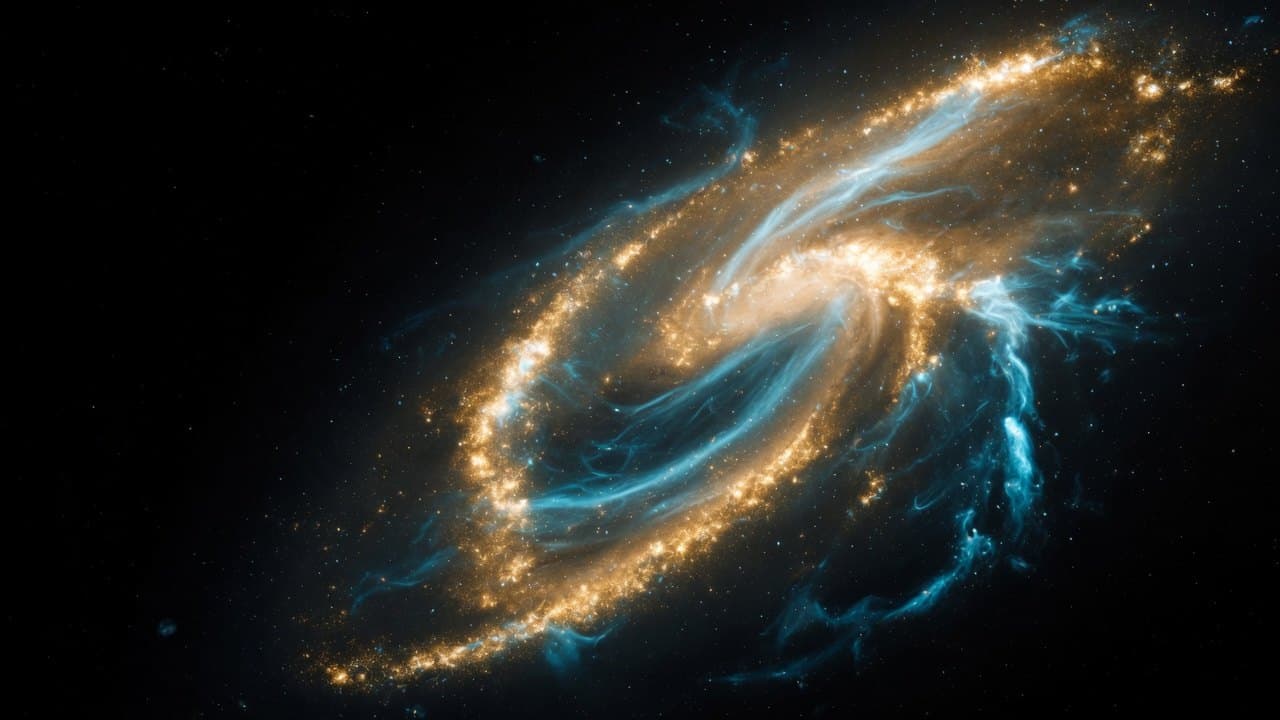
What the evidence says
Each claim has a specific scope. A source can support an observation while leaving its interpretation open.
- Reported observationSupported within stated scope
The reported sample comprised 21 extreme debris-disc systems, combining observations of 16 systems with Webb and five from archival Spitzer data.[1]
Scope: Reported sample and telescope allocation; not all young planetary systems.
Limit: Institutional release inspected; underlying paper abstract/metadata cross-checked but full text and raw spectra remain uninspected.
Inspect evidence and review history
- Claim review
- draft · separate agent scoped source cross check · Independent review pending
- Review scope
- Independent editorial pass within the same agent team; not independent scientific validation or replication.
- Editorial review receipt
- Inspect this revision's review record
- Source check
- · next review
- Record
- claim-debris-sample · revision 2
- [1] Webb provides crash course on planet-shattering collisions
Relation: supports. Locator: Science release: sample paragraph, beginning with rarity and the 21-disc sample.
Relevant source sections re-inspected by a separate editorial agent; no scientific replication performed.
- InterpretationTentative
The authors interpret silica-rich debris as evidence consistent with energetic collisions between large planetary bodies.[1]
Scope: Authors' interpretation of silica-rich spectra in a selected sample.
Limit: Planetary impacts and impactor sizes are inferred from spectra and physical models. Collisions were not directly observed; mineralogy/age interpretation remains to be tested in larger samples.
Inspect evidence and review history
- Claim review
- draft · separate agent scoped source cross check · Independent review pending
- Review scope
- Independent editorial pass within the same agent team; not independent scientific validation or replication.
- Editorial review receipt
- Inspect this revision's review record
- Source check
- · next review
- Record
- claim-debris-interpretation · revision 2
- [1] Webb provides crash course on planet-shattering collisions
Relation: supports. Locator: Science release: mineralogical categories and approximately one-third silica-rich fraction.
Relevant source sections re-inspected by a separate editorial agent; no scientific replication performed.
The next useful question
Which additional observations would discriminate collision mechanisms?
Sources and footnotes
These references identify the evidence used above. Read the inspected scope and each claim's limit before carrying the conclusion elsewhere.
Webb provides crash course on planet-shattering collisions
institutional research reportPublished RetrievedInspection: relevant sections. Sections: Dated release; sample paragraph (21 systems: 16 Webb, 5 archival Spitzer); mineralogy and collision interpretation; explicit age/sample limitation.
ESA/Webb institutional release directly inspected. Full IOP paper retrieval failed.
Update checks: not independently checked.
Further reading
Related material is separate from the references used to support the claims.
Extreme Debris Disks: Insights into Violent Collisions in Planet Formation and Destruction
research paper · peer reviewed version of recordPublished First preprint RetrievedInspection: abstract only. Sections: Publisher title, authors and publication date via primary-site search index; abstract from arXiv record 2607.06684.
Retrieval limit: IOP full text and direct arXiv HTML/abstract retrieval failed. Only indexed abstract and metadata inspected; no new claim-support edge relies on uninspected full text.
Update checks: not independently checked.